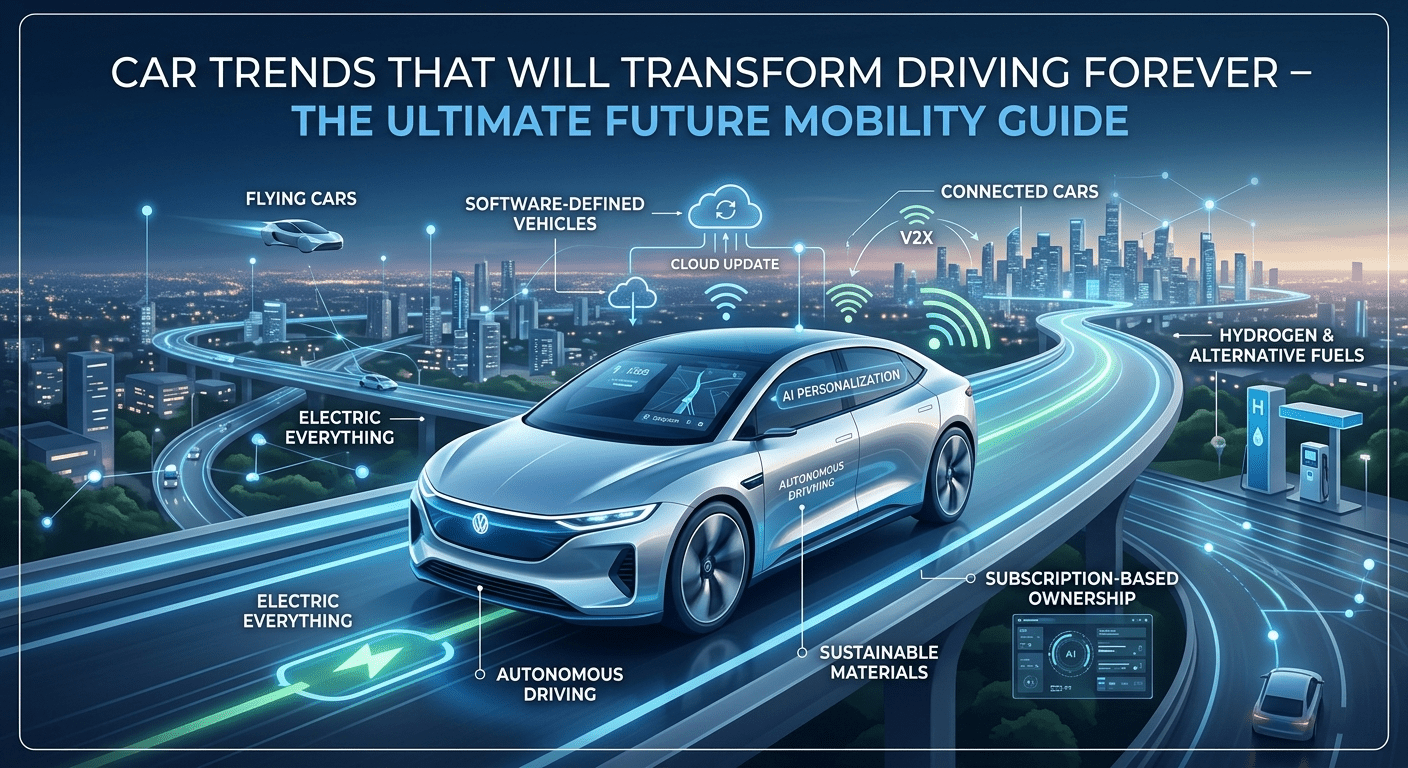
Car trends that will change driving forever are no longer sitting in concept garages covered in dust and “coming soon” labels. They are here—quietly reshaping how we drive, own, and even think about cars. The modern automobile is going through something of an identity crisis. It’s no longer just a machine with four wheels and an engine; it’s becoming a device, a service, and occasionally, a therapist that plays music when it senses your mood.
If cars had personalities, the ones of tomorrow would probably be that overachieving friend who tracks your sleep, reminds you to hydrate, and somehow still has time to update itself overnight.
Let’s break down the top 10 car trends that will change driving forever, looking at design, performance, ideology, cost, and what it all means for you—the person still deciding whether to floor it or save fuel.
Electric Everything
The shift to electric vehicles is less of a trend and more of a takeover. Internal combustion engines are slowly becoming the flip phones of the automotive world—still functional, but increasingly out of fashion.
Design & Performance
Electric cars have flipped traditional design logic. Without bulky engines, designers now have freedom—flat floors, more cabin space, and interiors that look like minimalist apartments.
Performance-wise, electric cars deliver instant torque. No waiting, no drama—just acceleration that feels like your car skipped the “thinking about it” phase and went straight to action.
Ideology
This shift is driven by environmental pressure, regulations, and a collective realization that breathing clean air is a decent idea.
Budget & Ownership Cost
- Higher upfront cost
- Lower running and maintenance cost
- Charging infrastructure still catching up in some regions
Thought
Owning an EV feels a bit like switching from cash to digital payments. At first, it seems unfamiliar. Then one day, you wonder how you ever lived without it.
Autonomous Driving
Self-driving cars are not fully here yet, but they’re close enough to make you slightly uncomfortable—in a fascinating way.
Features
- Adaptive cruise control
- Lane centering
- Semi-autonomous highway driving
Performance
Autonomous systems prioritize smoothness over aggression. Your car will never try to impress anyone at a traffic signal. It has no ego—and that alone makes it better than most drivers.
Cost
Currently expensive and limited to premium vehicles, but gradually moving toward the mainstream.
Thought
The real question is not whether cars can drive themselves. It’s whether humans are ready to give up control. For many, the steering wheel is not just a tool—it’s an identity.
Software-Defined Vehicles
Cars are becoming software platforms. The hardware is just the beginning; the real experience is controlled by code.
Features
- Over-the-air updates
- Feature unlocks through subscriptions
- App-based controls
Ideology
Your car is no longer a finished product when you buy it. It evolves. Improves. Occasionally asks for updates at inconvenient times—just like your phone.
Cost
You may end up paying for features long after purchasing the car. Heated seats might come with a monthly bill, which sounds absurd until you realize people already pay for cloud storage.
Thought
The line between “owning a car” and “subscribing to a service” is quietly disappearing.
Connected Cars
Cars are becoming part of a larger ecosystem. They talk to your phone, your home, and increasingly, to other vehicles.
Features
- Real-time traffic updates
- Remote vehicle control
- Integration with smart home systems
Thought
The car used to be an escape from the world. Now it’s an extension of it. Whether that’s progress or intrusion depends on how much you enjoy notifications.
Sustainable Materials
The future of car interiors is not just about luxury—it’s about responsibility.
Design
- Vegan leather alternatives
- Recycled materials
- Sustainable manufacturing processes
Ideology
Automakers are realizing that sustainability is not just about emissions; it’s about the entire lifecycle of the car.
Thought
There’s something ironic about sitting in a luxury car made from recycled bottles. It’s both progress and a reminder of how much we’ve consumed.
Subscription-Based Ownership
Ownership is being challenged by flexibility.
Concept
- Monthly subscription
- Access to multiple vehicles
- Maintenance included
Cost
Convenient in the short term, potentially expensive in the long run.
Thought
This model reflects a broader shift in society. People no longer want to own things—they want access to them. Cars are simply the latest addition to that mindset.
AI Personalization
Cars are becoming increasingly aware of their drivers.
Features
- Personalized settings
- Predictive navigation
- Voice assistants
Thought
When your car knows your favorite playlist, your driving habits, and your schedule, it starts to feel less like a machine and more like a quiet observer of your life.
Hydrogen & Alternative Fuels
While electric vehicles dominate headlines, hydrogen quietly continues its journey.
Performance
- Fast refueling
- Long driving range
Challenges
- Limited infrastructure
- High production cost
Thought
Hydrogen feels like the “other path” in a story where electricity took the lead role. It may not win the popularity contest, but it refuses to disappear.
Lightweight Engineering
Reducing weight has always been key to performance, and that principle is becoming even more important.
Design
- Carbon fiber components
- Aluminum structures
Performance
- Better efficiency
- Improved acceleration
Thought
The idea is simple: remove what you don’t need. It’s a philosophy that applies equally well to cars and life.
Flying Cars
Flying cars are moving from imagination to experimentation.
Features
- Vertical takeoff systems
- Urban air mobility solutions
Cost
Currently expensive and limited, but gradually evolving.
Thought
Flying cars promise to solve traffic problems by moving them into the sky. Whether that’s innovation or just relocating chaos remains to be seen.
Performance & Power Snapshot
| Trend | Power Potential | Efficiency | Cost Impact |
| Electric Vehicles | 300–1000 hp | High | Medium |
| Hydrogen Vehicles | 150–400 hp | High | High |
| Lightweight Cars | Enhanced | Very High | Medium |
Ownership Cost Breakdown
- Electric vehicles: lower running costs, fewer maintenance issues
- Traditional cars: higher fuel dependency
- Subscription models: flexibility at a premium
- Autonomous features: added cost for convenience
External Resources
More Articles You Shouldn’t Miss
- Skoda Kushaq Facelift 2026: Bold Upgrade or Overhyped Refresh? (Full Review)
- Renault Duster 2026 – The Comeback of the SUV That Refuses to Quit
- TVS Orbiter v1: A New Electric Scooter That Could Redefine City Riding
Verdict: The Road Ahead
Car trends that will change driving forever are not just about technology—they’re about redefining our relationship with mobility. Cars are becoming smarter, cleaner, and more connected, but also more complex and, in some ways, less personal.
The future of driving might involve less driving altogether. The steering wheel may become optional, ownership may become temporary, and cars may become less about control and more about experience.
In the end, the biggest shift is not in the machine—it’s in us. We are moving from being drivers to being passengers in a system that is learning to move on its own.
And perhaps the most interesting question is this: when cars no longer need us, will we still need them in the same way?