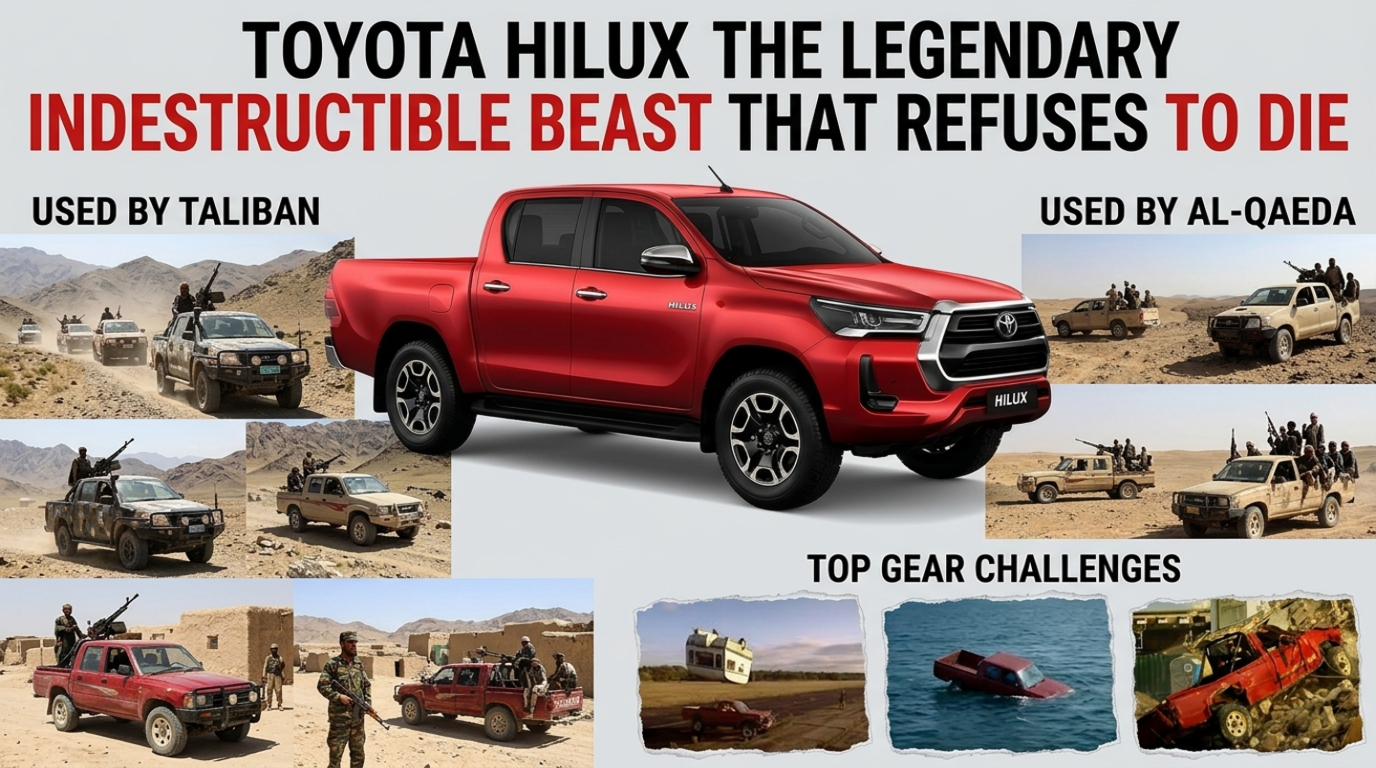
There are cars… and then there’s the Toyota Hilux.
From war zones to polar expeditions, from muddy farms to city streets, the Toyota Hilux has built a reputation that most vehicles can only dream of. It’s not just reliable—it’s borderline immortal.
If cars had personalities, the Hilux would be that one friend who walks away from chaos without a scratch and says, “Bas itna hi?”
Toyota Hilux Design: Built Like a Tank
The Toyota Hilux doesn’t care about looking pretty—it cares about surviving.
- Built on a ladder-frame chassis, the same philosophy used in trucks and military vehicles
- High ground clearance that laughs at potholes
- Reinforced suspension designed for abuse
- Minimal unnecessary electronics (especially in older models)
While modern SUVs are busy flexing LED lights, the Hilux is flexing its bones of steel.
Comparison:
If a luxury SUV is a smartphone, the Hilux is a Nokia 3310.
Performance That Refuses to Quit
Under the hood, the Toyota Hilux is not about speed—it’s about endurance.
- Diesel engines known for long life cycles
- High torque output perfect for off-roading and hauling
- 4×4 drivetrain capable of tackling sand, mud, rocks, and snow
- Reliable manual and automatic transmissions
It’s not fast—but it will get you there. Even if “there” is a mountain with no road.
Quote:
“Speed impresses, but endurance wins wars.”
Features: Rugged Outside, Comfortable Inside
The modern Toyota Hilux has evolved:
- Touchscreen infotainment system
- Apple CarPlay and Android Auto
- Advanced safety features like traction control and hill assist
- Comfortable seating and premium materials (in higher variants)
It’s like a soldier who now also knows how to wear a suit.
The Top Gear Torture Test: When Humans Tried to Kill a Toyota Hilux
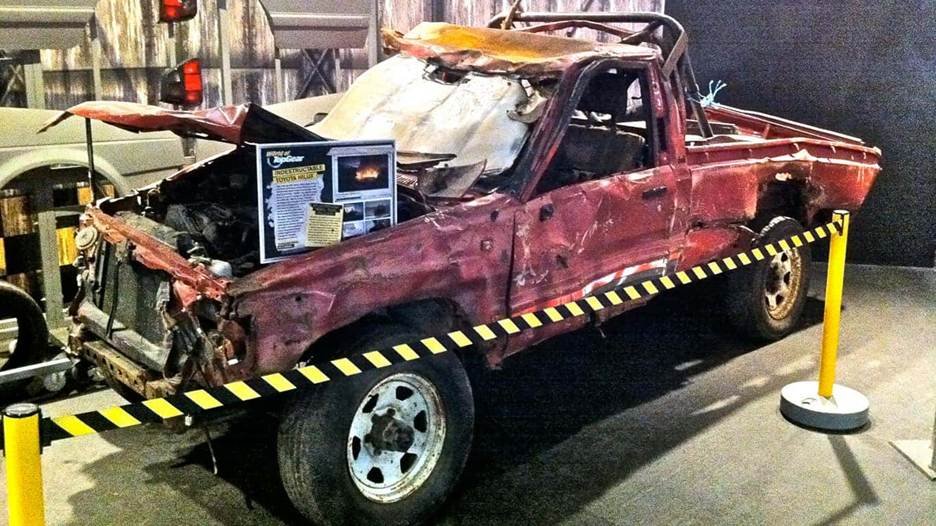
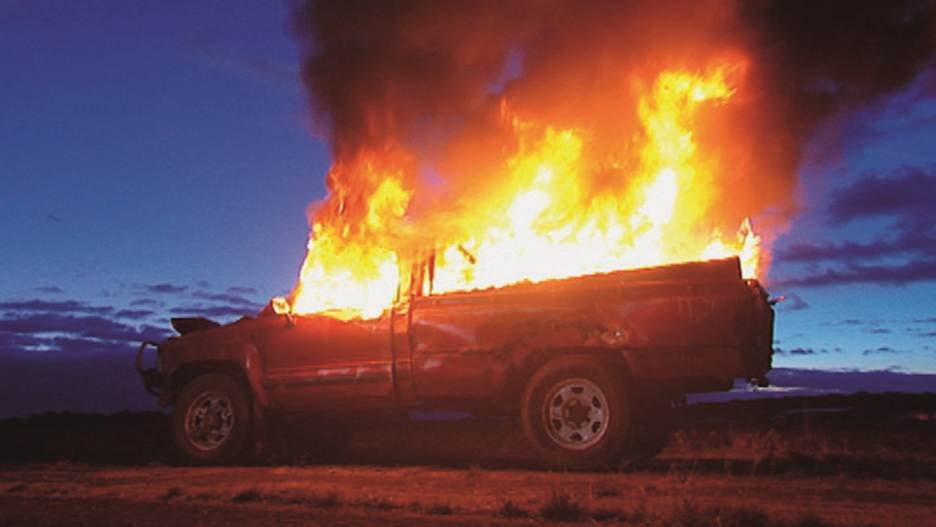
The legendary British show Top Gear once asked a simple question:
“Can you kill a Toyota Hilux?”
Spoiler: You can’t.
They tried everything:
- Crashing it into objects
- Submerging it in the ocean
- Setting it on fire
- Dropping a building on it
And yet… it started. With minimal repairs.
That episode didn’t just entertain—it cemented the Hilux’s status as automotive folklore.
Toyota Hilux in Conflict Zones: A Tool of Survival (and War)
The Toyota Hilux has gained a controversial reputation due to its usage in conflict zones.
Groups like the Taliban and Al-Qaeda have used Hilux pickups extensively.
Why?
- Easy to repair anywhere
- Can carry heavy weapons or cargo
- Reliable in extreme conditions
- Works without advanced infrastructure
Important Note:
This isn’t a reflection of the vehicle’s intent—but rather its capability. A tool is only as good (or bad) as the hands that use it.
Deep Thought:
“When a machine becomes this dependable, it stops being a product—and becomes a symbol.”
Why Toyota Hilux is So Reliable
Let’s break down the secret sauce:
1. Overengineering
Toyota builds the Hilux stronger than necessary. It’s designed for worst-case scenarios.
2. Simple Engineering
Fewer complex systems = fewer things that can fail.
3. Global Testing
From African deserts to Arctic snow, the Hilux is tested everywhere.
4. Proven Track Record
Decades of real-world abuse have refined its design.
5. Parts Availability
Even in remote villages, you’ll find someone who can fix a Hilux.
Future of Toyota Hilux
Toyota isn’t stopping.
Future developments include:
- Hybrid Hilux models
- Potential electric variants
- Improved safety tech
- Better fuel efficiency
Toyota is essentially asking:
“What if an indestructible truck also became eco-friendly?”
Verdict: A Machine That Became a Myth
The Toyota Hilux is not just a pickup—it’s a legend on wheels.
Pros
- Unmatched reliability
- Excellent off-road capability
- Long lifespan
- Strong resale value
Cons
- Not the most comfortable ride
- Expensive in some markets
- Not performance-focused
Final Thoughts
In a world where most products are designed to be replaced, the Toyota Hilux stands as a rebellion.
It doesn’t just survive—it endures.
It doesn’t just work—it refuses to stop working.
And maybe that’s why people don’t just buy a Hilux…
They trust it with their lives.