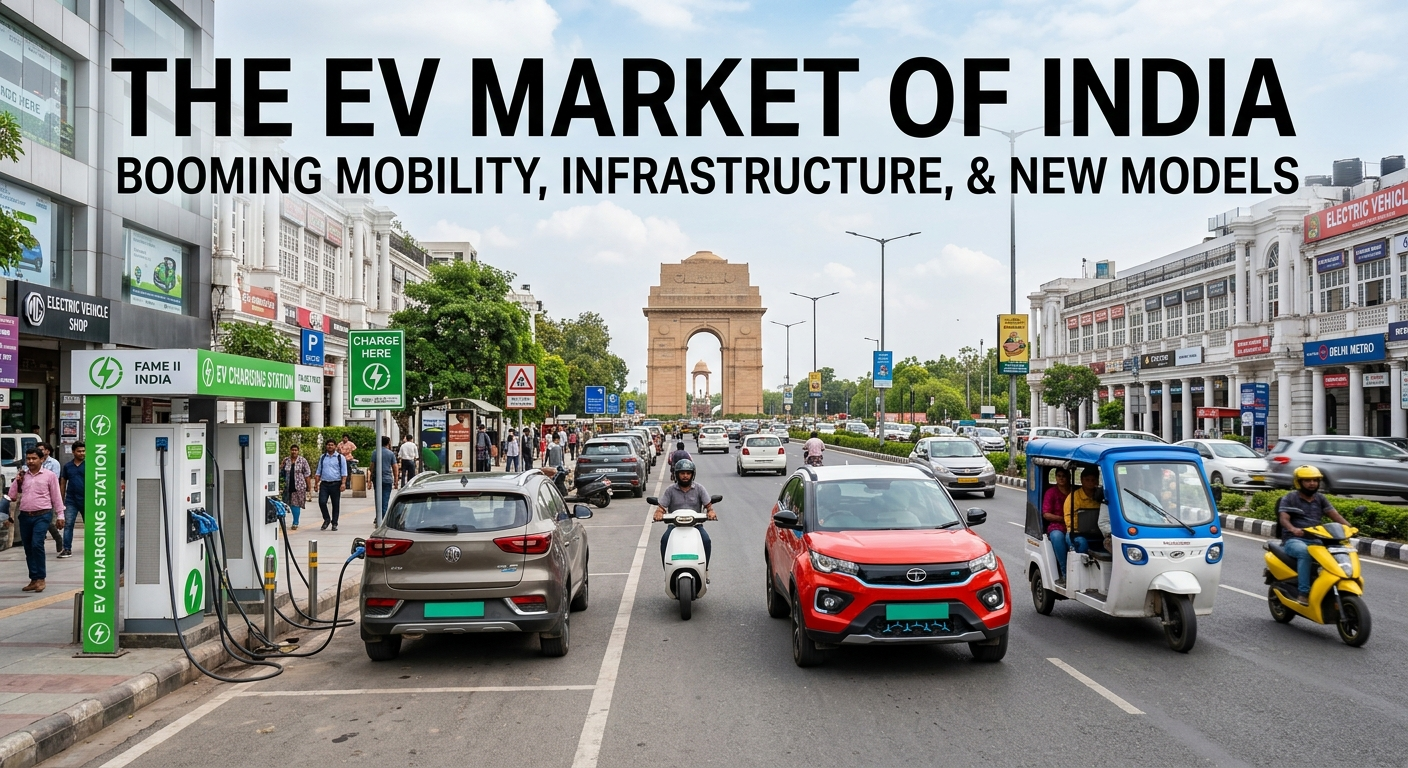
Electric Vehicles in India are no longer that “one futuristic car your tech-savvy friend keeps talking about.” They’ve officially entered the mainstream—and quite confidently, too. With rising fuel prices that seem to have a personal grudge against your wallet, government incentives, and a growing awareness about sustainability, EVs are now a serious alternative to petrol and diesel vehicles.
In this blog, we’ll explore Electric Vehicles in India in detail—covering design, performance, braking systems, features, charging infrastructure, upcoming launches, and ultimately answering the big question: are EVs truly worth it right now?
Electric Vehicles in India: Market Overview and Growth Trends
Electric Vehicles in India have seen impressive growth in recent years. What started as a cautious shift has now turned into a full-blown transition. Government initiatives such as FAME II and state subsidies have played a major role—but let’s be honest, skyrocketing fuel prices have also been a very convincing salesperson.
Key Highlights
- EV sales have crossed approximately 1.5 million units annually across segments
- Leading manufacturers include Tata Motors, Mahindra, MG Motor, Hyundai, and BYD
- Major adoption is concentrated in metropolitan cities such as Delhi, Mumbai, and Bengaluru
According to NITI Aayog, the EV market in India is expected to grow significantly over the next decade. In simple terms, EVs are not just coming—they’ve already parked themselves in the market and are here to stay.
Design Evolution of Electric Vehicles in India
Electric Vehicles in India have undergone a major glow-up. Early EVs were all about function over form. Today, they look like they belong in a sci-fi movie—minus the flying part (for now).
Design Trends
- Closed front grilles that improve aerodynamics and give a clean look
- Sleek LED lighting that adds a futuristic touch
- Aerodynamic body structures designed to squeeze out every extra kilometer of range
- Minimalist interiors with large infotainment displays
Manufacturers are clearly putting effort into making EVs stand out. After all, if you’re driving the future, it might as well look the part.
Performance and Driving Experience
Electric Vehicles in India offer a driving experience that feels surprisingly premium—even in mid-range models. The first time you press the accelerator, the instant torque might catch you off guard in the best way possible.
Performance Highlights
- Instant torque delivery leading to quick acceleration
- Quiet and vibration-free driving experience
- Ideal for city driving, especially in traffic-heavy conditions
However, it’s not all perfect:
- Range anxiety still exists, especially for highway drives
- Performance can vary in extreme weather conditions
Models like the Tata Nexon EV and MG ZS EV offer ranges exceeding 400 km, which is more than enough for daily commutes—unless your daily commute involves crossing state borders.
Braking and Safety Technology
Electric Vehicles in India bring an interesting twist to braking—your car actually helps recharge itself while slowing down. It’s like getting cashback every time you brake.
Key Safety Features
- Regenerative braking systems that recover energy during deceleration
- Anti-lock Braking System (ABS) with Electronic Brakeforce Distribution (EBD)
- Electronic Stability Control (ESC)
- Advanced Driver Assistance Systems (ADAS) in premium models
Regenerative braking not only improves efficiency but also makes city driving smoother, especially in stop-and-go traffic.
Features and Technology
Electric Vehicles in India are packed with technology—sometimes to the point where your car feels smarter than your phone.
Feature Highlights
- Large touchscreen infotainment systems
- Connected car technology with remote access
- Over-the-air (OTA) updates that keep the vehicle updated
- Fully digital instrument clusters
- Voice-enabled controls
One standout advantage is convenience. Features like remote climate control mean your car can be cool and comfortable before you even step inside—something you’ll truly appreciate during Indian summers.
Charging Infrastructure in India
Charging infrastructure is often the biggest concern when discussing Electric Vehicles in India—and understandably so.
Current Scenario
- Public charging networks are expanding steadily in urban areas
- Fast chargers are becoming more common on highways
- Home charging remains the most practical and reliable option
Challenges
- Limited infrastructure in rural and semi-urban regions
- Charging still takes significantly longer than refueling
The Bureau of Energy Efficiency continues to support infrastructure development, but for now, planning ahead is still part of the EV ownership experience.
Current Models
Expected Improvements
- Driving ranges exceeding 500 km
- Faster charging times
- More competitive pricing
These upcoming models indicate that EVs are moving towards becoming not just an alternative—but the default choice.
Pros and Cons of Electric Vehicles in India
Advantages
- Lower running and maintenance costs
- Reduced environmental impact
- Smooth and refined driving experience
- Government incentives and tax benefits
Disadvantages
- Higher upfront cost
- Charging infrastructure still developing
- Battery replacement costs in the long term
Verdict
Electric Vehicles in India have reached a point where they are practical for a large number of users, especially those with predictable daily travel and access to home charging.
Yes, there are still a few hurdles—charging infrastructure and initial cost being the main ones. But the progress being made suggests that these challenges are temporary.
For city users, EVs already make strong sense. For highway-heavy users, waiting a little longer might be the smarter move.
One thing is certain: Electric Vehicles in India are not just a trend. They are a shift in how we think about mobility. And like all big shifts, it may take time—but it is clearly moving in one direction.