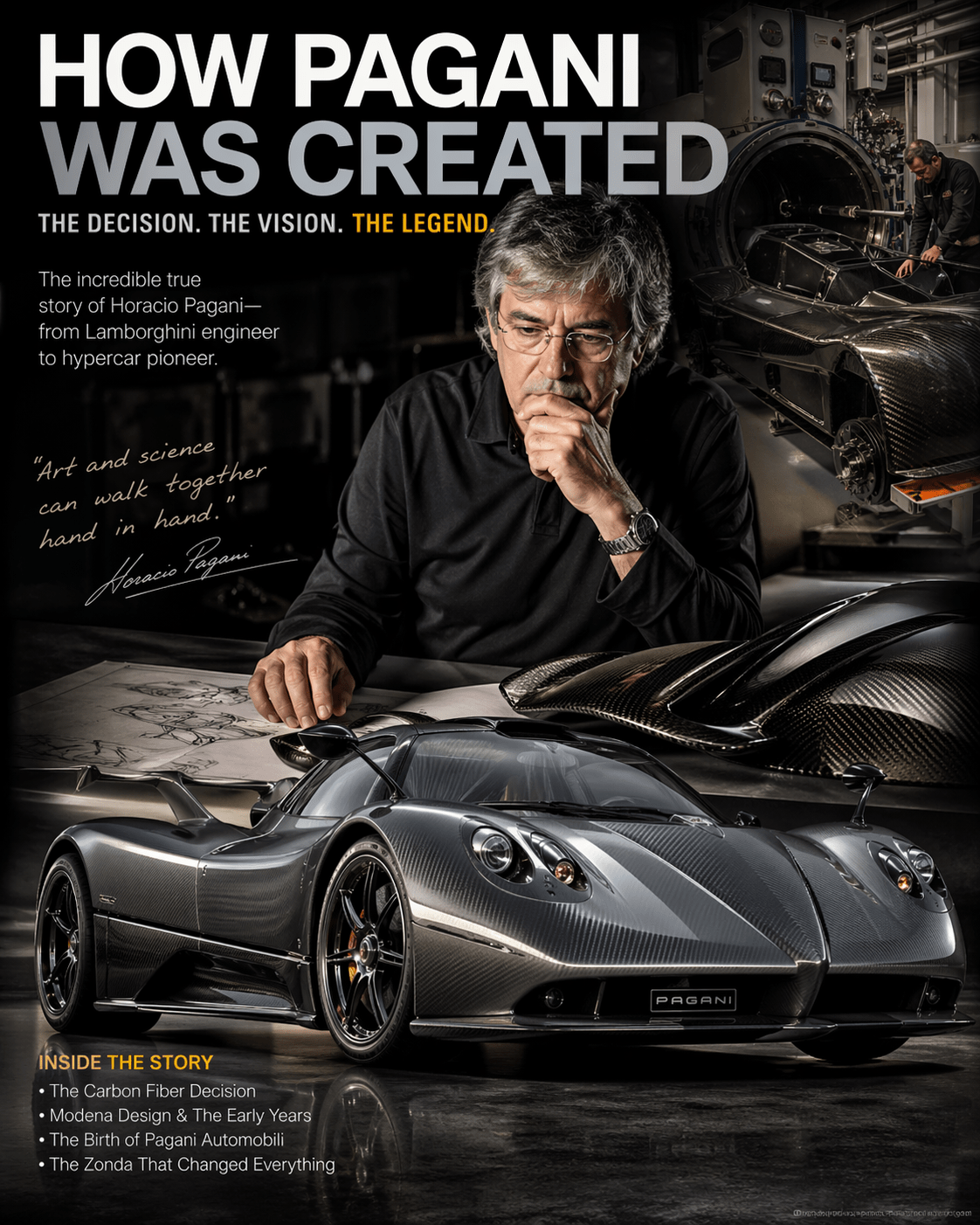
How Pagani was created is not a story of rebellion for the sake of ego—it’s a story of technical conviction meeting long-term vision.
In an era dominated by giants like Ferrari and Lamborghini, one engineer quietly built the foundation for something radically different.
Not louder. Not faster (at least not initially).
Just… fundamentally smarter.
Horacio Pagani and the Art–Science Philosophy
To understand how Pagani was created, you start with Horacio Pagani.
Unlike traditional automotive engineers, Pagani approached car design through the lens of Leonardo da Vinci:
“Art and science can walk together hand in hand.”
And he meant it literally.
Where others saw:
- Engineering constraints
Pagani saw:
- Material expression
- Structural beauty
- Emotional design
That philosophical difference becomes critical later.
How Pagani Was Created at Lamborghini
Before founding his own company, Pagani worked at Lamborghini, contributing to advanced composite development.
Let’s correct a common myth:
He didn’t “just start as a janitor.”
He arrived in Italy with strong engineering capability, though he did begin modestly and worked his way up quickly.
At Lamborghini, he became deeply involved in composite materials, especially carbon fiber—long before it became industry standard.
The Carbon Fiber Decision That Changed Everything
This is the pivotal chapter in how Pagani was created.
During the 1980s, Pagani proposed that Lamborghini invest in:
- Carbon fiber production
- Autoclave technology (critical for high-quality composites)
Lamborghini declined.
Not because the idea was wrong—but because:
- It was expensive
- It seemed unnecessary at the time
- Even Ferrari wasn’t fully committed to it yet
Here’s the key nuance:
Pagani didn’t leave immediately in protest.
Instead, he did something far more strategic.
He invested in the technology himself.
That’s the real decision behind how Pagani was created.
From Modena Design to Pagani Automobili
Rather than walking away dramatically, Pagani built leverage.
He founded Modena Design, a consultancy specializing in carbon fiber engineering. The company:
- Supplied components to automotive and motorsport clients
- Continued collaborating within the industry
- Built technical credibility and financial independence
Only after establishing this foundation did he take the next step:
He founded Pagani Automobili in 1992.
This distinction matters.
Pagani Automobili wasn’t born out of rejection.
It was the natural evolution of proven capability.
The Zonda and Industry Disruption
The culmination of how Pagani was created arrived with the Pagani Zonda in 1999 at the Geneva Motor Show.
It wasn’t just another supercar launch.
It was a statement.
What made the Zonda different:
- Extensive carbon fiber construction (years ahead of industry adoption)
- V12 engines from Mercedes-Benz AMG
- Design influenced by aerospace and art—not just wind tunnels
An often overlooked detail:
Juan Manuel Fangio, a five-time F1 champion, supported Pagani and helped establish early credibility—including the AMG connection.
The Zonda didn’t just validate Pagani’s ideas.
It exposed how conservative the rest of the industry had been.
What Makes Pagani Unique Today
Understanding how Pagani was created explains why the brand still feels fundamentally different.
Cars like the Pagani Huayra are not built for scale.
They are built for:
- Precision
- Material innovation
- Emotional impact
Pagani doesn’t chase volume.
It chases perfection per unit.
In a spreadsheet-driven industry, that’s almost rebellious.
External Resources
- Official Pagani website:
https://www.pagani.com - Carbon fiber engineering overview:
https://www.sciencedirect.com/topics/engineering/carbon-fiber
More Articles You Shouldn’t Miss
Renault Duster 2026 – The Comeback of the SUV That Refuses to Quit
TVS Orbiter v1: A New Electric Scooter That Could Redefine City Riding
Skoda Kushaq Facelift 2026: Bold Upgrade or Overhyped Refresh? (Full Review)
Lessons from How Pagani Was Created
1. You don’t need permission to innovate
Pagani didn’t wait for institutional approval.
2. Build capability before building a brand
Modena Design came before Pagani Automobili.
3. Industry leaders are not always early adopters
Even giants hesitate.
4. Art + engineering = differentiation
Most brands optimize performance. Pagani optimizes experience.
Conclusion
At its core, how Pagani was created isn’t about a dramatic fallout—it’s about a methodical divergence.
Horacio Pagani didn’t storm out of Lamborghini.
He simply chose a different path—and invested in proving it right.
And in doing so, he didn’t just build a car company.
He built one of the most respected hypercar brands in the world—quietly, precisely, and beautifully.