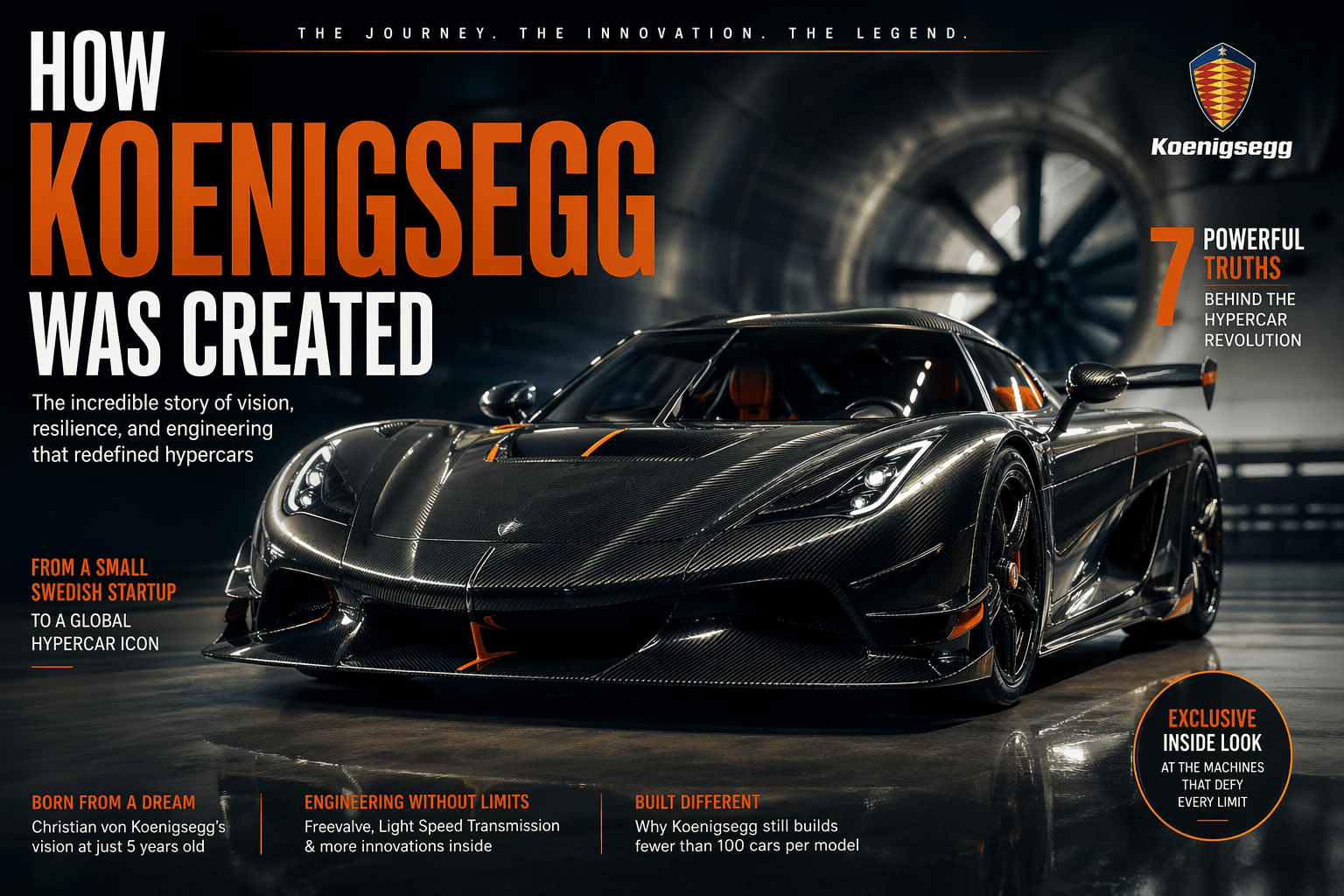
How Koenigsegg was created is less about building cars and more about challenging the limits of what engineering can achieve. In an industry dominated by legacy brands, one Swedish company rewrote the rules—not with scale, but with precision, innovation, and relentless intent.
The Vision of Christian von Koenigsegg
At the center of how Koenigsegg was created is a singular vision. As a child, Christian watched a film about building a race car—an idea that evolved into a lifelong mission.
Unlike most automotive founders, he didn’t inherit a legacy or industrial empire. What he had instead was clarity:
Build the best performance car in the world. Not one of the best—the best.
How Koenigsegg Was Created in 1994
In August 1994, Koenigsegg Automotive AB was officially founded.
At that point, the company fit every definition of a startup:
- Minimal capital
- Limited infrastructure
- A small, highly specialized team
But here’s the nuance: while it began as a “small Swedish startup,” Koenigsegg was always engineering-first. Even in its early days, the focus wasn’t volume—it was breakthrough performance.
That philosophy still defines the company in 2026, where production remains intentionally limited—often fewer than 100 units per model—not due to inability, but due to extreme complexity and craftsmanship.
Early Challenges and the 2003 Fire
Any honest account of how Koenigsegg was created has to include setbacks—and one of the biggest came in 2003.
A fire destroyed their Margretetorp facility just before the Geneva Motor Show.
This wasn’t just a logistical problem—it was existential.
However, two critical details often get overlooked:
- Many cars, components, and tools were successfully saved
- The team resumed operations remarkably quickly
Koenigsegg then relocated to a former Swedish Air Force base (F10) in Ängelholm—a move that ultimately became iconic. The facility provided space for testing, production, and innovation under one roof.
In a strange way, the setback became an upgrade.
The First Prototype and Breakthrough
By 1996, Koenigsegg had developed its first running prototype—the CC.
This marked the transition from concept to credibility.
Key characteristics included:
- Lightweight construction
- Aerodynamic efficiency
- Performance-first engineering
The production evolution, the CC8S (2002), went on to earn recognition from Guinness World Records for the most powerful production engine at the time.
For a company less than a decade old, that wasn’t just impressive—it was disruptive.
Engineering Innovation and Freevalve
Understanding how Koenigsegg was created requires looking beyond cars into engineering philosophy.
Koenigsegg doesn’t iterate—it rethinks systems from first principles.
A prime example is Freevalve:
- Developed under a sister company within the Koenigsegg ecosystem
- Eliminates the traditional camshaft
- Allows fully variable valve control for improved efficiency and performance
This distinction matters: Freevalve isn’t just a feature—it’s part of a broader engineering network tied to Koenigsegg’s leadership and R&D culture.
Other innovations include:
- Light Speed Transmission (multi-clutch, near-instant shifting)
- Direct Drive system (removing traditional gearboxes in hybrids)
- Advanced carbon fiber chassis design
Koenigsegg in 2026
As of 2026, Koenigsegg operates as a boutique hypercar manufacturer with global recognition.
Its lineup includes:
- Jesko
- Regera
- Gemera
Despite competing with industry giants, Koenigsegg maintains:
- Extremely low production volume
- High engineering density per vehicle
- A reputation for redefining performance benchmarks
They’re not trying to be the biggest—they’re trying to be the most advanced.
Key Takeaways from How Koenigsegg Was Created
Precision Over Scale
Koenigsegg proves that small teams can outperform large organizations with the right focus.
Setbacks Can Be Strategic
The 2003 fire didn’t end the company—it repositioned it.
Innovation Is a System, Not a Feature
From Freevalve to transmissions, every component is reimagined.
Long-Term Vision Wins
This wasn’t overnight success—it was decades of consistent execution.
External Resources
- Official site: https://www.koenigsegg.com
- Engineering research: https://www.sae.org
- Industry coverage: https://www.topgear.com
More Articles You Shouldn’t Miss
Renault Duster 2026 – The Comeback of the SUV That Refuses to Quit
TVS Orbiter v1: A New Electric Scooter That Could Redefine City Riding
Skoda Kushaq Facelift 2026: Bold Upgrade or Overhyped Refresh? (Full Review)
Conclusion
How Koenigsegg was created is ultimately a study in controlled ambition. Not loud, not rushed—just relentlessly precise.
From a modest Swedish startup to one of the most technically advanced automotive companies in the world, Koenigsegg didn’t scale traditionally—it evolved deliberately.
And that’s what makes the story compelling:
It’s not about building more cars.
It’s about building better ones—every single time.