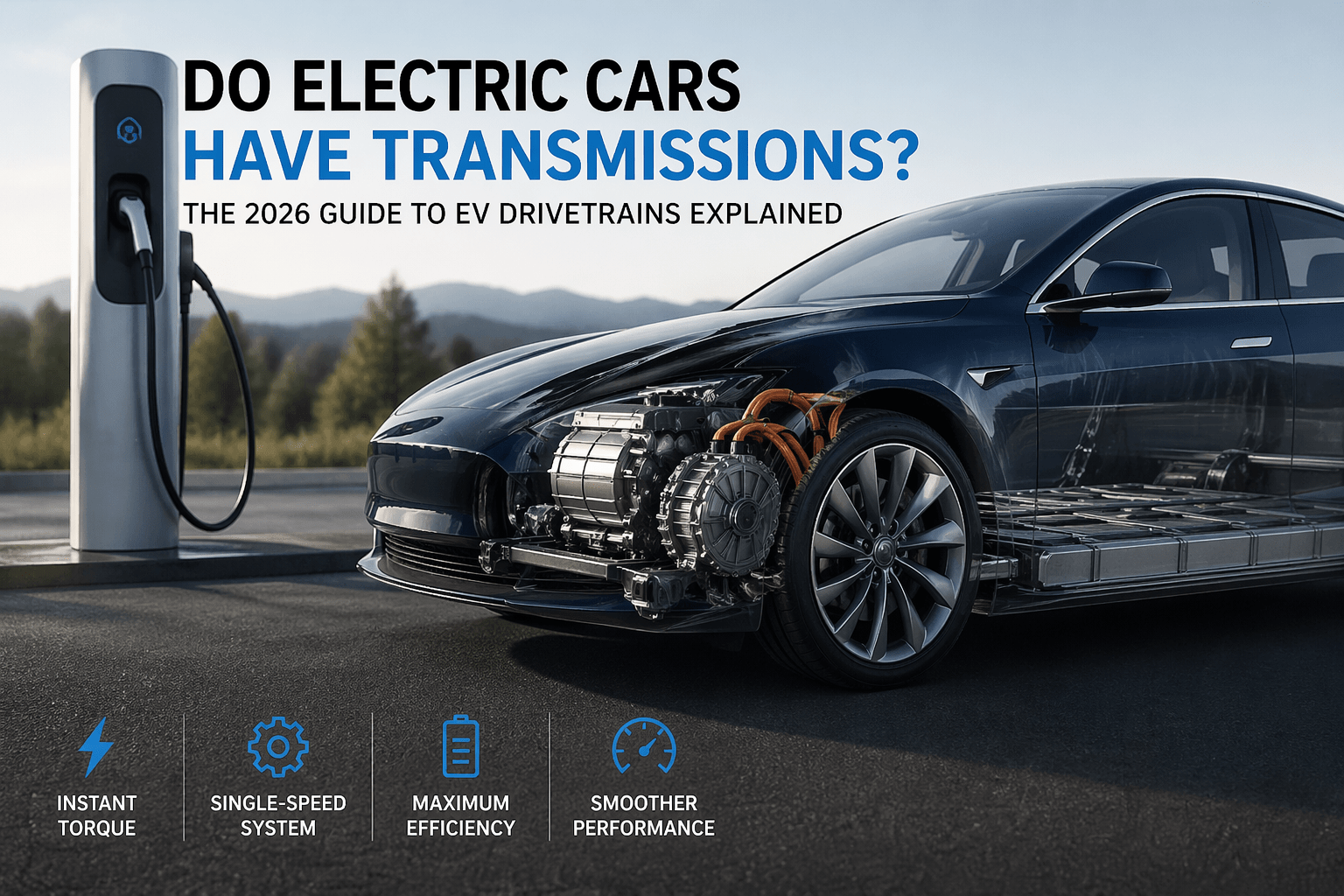
So, do electric cars have transmissions?
Short answer: Yes—but not in the way you’re used to.
Most electric vehicles (EVs) use a single-speed transmission rather than the complex multi-gear systems found in gasoline cars. That means no gear shifting, no clutch, and definitely no “Did I stall the car?” moments.
Think of it like this: if a traditional engine is a marathon runner that needs pacing (gears), an electric motor is a sprinter—it delivers power instantly, no warm-up required.
How Traditional Car Transmissions Work
Before we dive deeper into EVs, let’s quickly revisit how transmissions work in internal combustion engine (ICE) vehicles.
Cars powered by gasoline engines—like those from Toyota or Ford—use multi-speed transmissions because:
- Engines operate efficiently only within a narrow RPM range
- Different speeds require different torque outputs
- Gear shifting keeps the engine in its optimal performance zone
That’s why you have:
- Manual gearboxes (you shift)
- Automatic transmissions (car shifts for you)
- CVTs (continuously variable transmissions)
It’s a bit like cycling uphill vs. downhill—you need different gears to maintain efficiency.
How Electric Vehicle Drivetrains Differ
Electric vehicles—like those made by Tesla, Hyundai, and BYD—operate on an entirely different principle.
Key Differences:
- Electric motors deliver instant torque
- Wide RPM range without efficiency loss
- No need for constant gear adjustments
Instead of juggling multiple gears, EVs typically rely on:
- A single-speed reduction gear
- Direct power delivery to the wheels
This simplicity is one of the reasons EVs feel so smooth and responsive.
Why Most EVs Don’t Need Multi-Speed Transmissions
Here’s where things get interesting—and a little philosophical.
Gas engines need complexity to function efficiently. Electric motors, on the other hand, thrive in simplicity.
Reasons EVs Skip Multi-Gear Transmissions:
1. Instant Torque
Electric motors produce maximum torque from zero RPM. No buildup. No waiting.
2. Wide Operating Range
An EV motor can spin efficiently across a much broader speed range than a combustion engine.
3. Fewer Moving Parts
Less complexity = fewer failures = lower maintenance.
4. Better Efficiency
Every additional gear introduces friction and energy loss.
In short, adding gears to an EV is like adding stairs to an escalator—it works, but it defeats the purpose.
Do Any Electric Cars Use Gearboxes?
Now here’s a twist: some electric cars actually do use multi-speed transmissions.
Notable Examples:
- Porsche Taycan
- Audi e-tron GT
These vehicles use a two-speed transmission, mainly for performance reasons.
Why?
- First gear: explosive acceleration
- Second gear: improved efficiency at high speeds
This setup helps performance EVs maintain both:
- Lightning-fast launches
- Better highway efficiency
So yes, while most EVs keep it simple, high-performance models sometimes bend the rules.
Pros and Cons of EV Transmission Systems
Advantages
Smooth Driving Experience
No gear shifts = seamless acceleration.
Lower Maintenance
No clutch plates, fewer mechanical parts.
Higher Reliability
Simpler systems tend to last longer.
Quiet Operation
No gear changes means less noise.
Disadvantages
Limited Top-Speed Optimization
Single-speed systems can be less efficient at extreme speeds.
Performance Trade-offs
Multi-speed systems can extract more performance—but add complexity.
The Future of EV Transmissions (2026 and Beyond)
As of April 2026, the EV industry is evolving fast.
Trends to Watch:
1. Advanced Multi-Speed Systems for Performance EVs
Brands like Porsche are refining multi-speed tech.
2. Software-Defined Drivetrains
Instead of mechanical gears, software optimization is doing the heavy lifting.
3. In-Wheel Motors
Future EVs may eliminate traditional transmissions entirely.
4. Efficiency Optimization via AI
Smart systems will adjust torque delivery dynamically without physical gear changes.
External Resources (DoFollow Links)
- Learn more about EV drivetrains from
→ https://www.energy.gov/eere/electricvehicles/how-do-electric-cars-work - Detailed engineering breakdown by
→ https://www.sae.org
More Articles You Shouldn’t Miss
- TVS Orbiter v1: A New Electric Scooter That Could Redefine City Riding
- Skoda Kushaq Facelift 2026: Bold Upgrade or Overhyped Refresh? (Full Review)
- Renault Duster 2026 – The Comeback of the SUV That Refuses to Quit
Final Thoughts
So, circling back to the question—do electric cars have transmissions?
Yes, but they’ve taken the idea and stripped it down to its most efficient form. No drama, no gear-hunting, no awkward shifts—just smooth, instant power.
In a way, EVs challenge a long-standing assumption in automotive engineering: that complexity equals capability. Sometimes, the smartest system is the simplest one.
And maybe that’s the deeper takeaway here—not just about cars, but about technology itself.
Less noise. More motion.