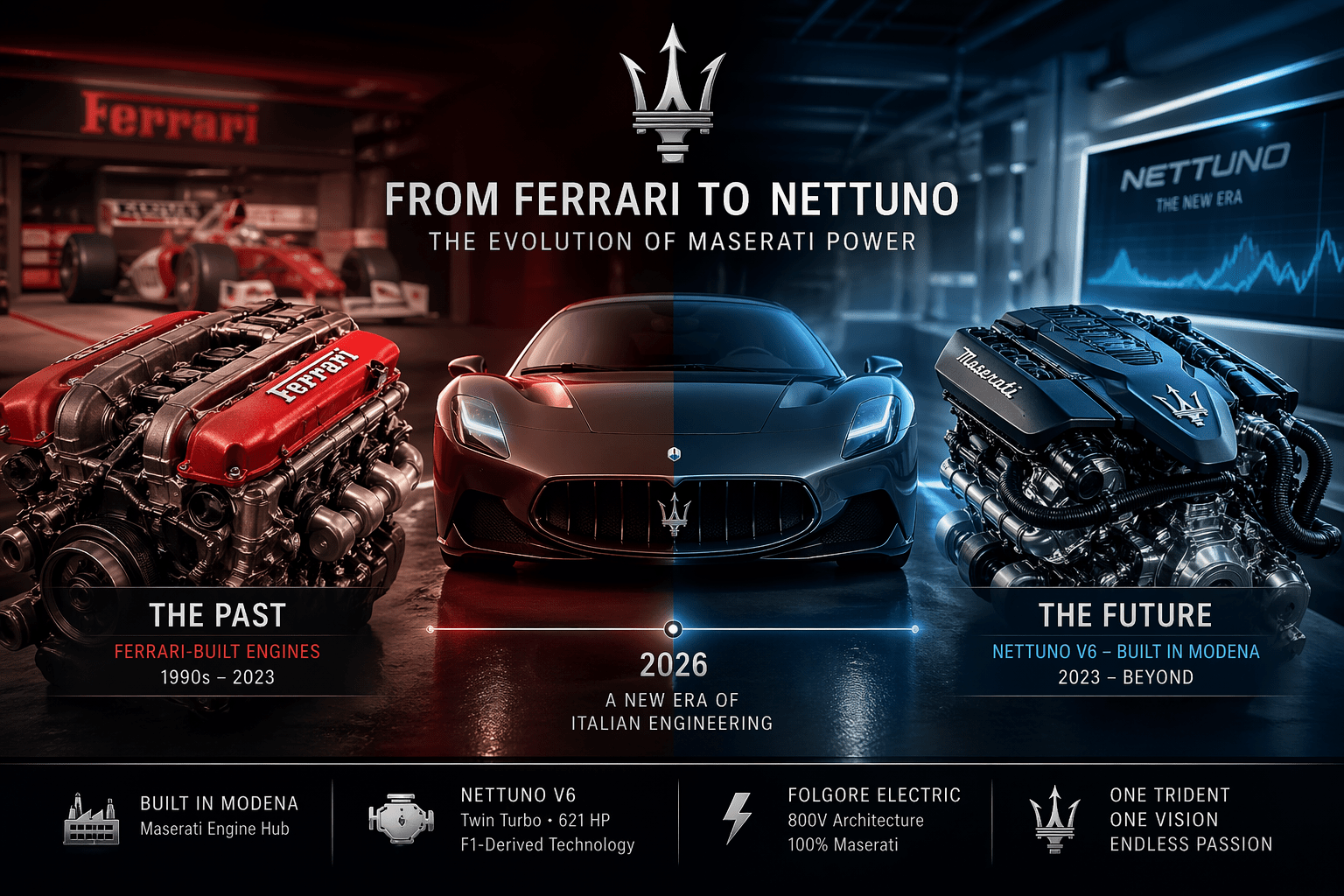
Who makes the engines for Maserati in 2026?
The short answer: Maserati builds most of its engines in-house today, especially high-performance ones like the Nettuno V6.
However, the full story is layered. Maserati engines have evolved from Ferrari-built masterpieces to independently engineered powertrains, with some shared technology from Stellantis for efficiency.
If you’re here for clarity—not marketing fluff—you’re in the right place.
The Ferrari Era: Who Made Maserati Engines Before?
To fully understand who makes the engines for Maserati, you need to look at its past.
From the late 1990s until the early 2020s, Ferrari played a central role in Maserati engine production.
What happened during this era?
- Ferrari controlled Maserati for a period
- Engines were built in Maranello
- Maserati models used Ferrari-derived V6 and V8 engines
Examples:
- Quattroporte (V8 Ferrari-derived engines)
- Levante Trofeo
- Ghibli V6
These engines gave Maserati cars a distinct identity—sharp throttle response and a soundtrack that could wake your neighbors and their ancestors.
But by 2023, this partnership officially ended. No new Maserati cars in 2026 use Ferrari engines.
Who Makes the Engines for Maserati Today (2026)
Now to the modern answer:
Who makes the engines for Maserati today?
Primarily, Maserati itself.
The brand has transitioned into a self-reliant performance manufacturer, producing engines at its facility in Modena.
Current Engine Sources (2026):
- High-performance engines → Maserati (in-house)
- Entry-level engines → Stellantis-based, Maserati-tuned
- Electric systems → Fully Maserati-developed
This shift isn’t just technical—it’s philosophical. Maserati is no longer borrowing identity; it’s building one.
The Nettuno Engine: Maserati’s Game-Changer
At the center of this transformation is the Maserati Nettuno Engine.
This engine is the clearest answer to who makes the engines for Maserati in the modern era.
Key Specifications:
- 3.0L twin-turbo V6
- ~621 hp
- Pre-chamber combustion (Formula 1-derived tech)
- Built at the Maserati Engine Hub in Modena
Why it matters:
The Nettuno engine proves Maserati doesn’t need Ferrari anymore.
It’s like moving out of your parents’ house… and immediately building a better one next door.
Do All Maserati Cars Use In-House Engines?
Not entirely—and this is where nuance matters.
If you’re still asking who makes the engines for Maserati across all models, here’s the precise breakdown:
Fully Maserati Engines:
- MC20 / MCPura
- GranTurismo
- GranCabrio
- Grecale Trofeo
These use the Nettuno V6, built in Modena.
Shared but Maserati-Tuned Engines:
- Grecale GT & Modena
- Some earlier Ghibli variants
These engines:
- Are based on Stellantis’ Global Medium Engine (GME) platform
- Share architecture with Alfa Romeo
- Feature Maserati-specific tuning, turbocharging, and hybrid systems
So yes, they share DNA—but they don’t drive the same.
Maserati, Stellantis, and Shared Engine Tech
Under Stellantis, Maserati benefits from scale without losing identity.
What this means:
- Faster development cycles
- Lower production costs
- Access to hybrid and modular platforms
Some engines are also assembled at Stellantis facilities like Termoli, while high-performance units remain a Modena specialty.
So when asking who makes the engines for Maserati, the accurate answer is:
Maserati leads performance engine development, supported by Stellantis infrastructure.
Maserati’s Electric Future: Folgore Models
The question who makes the engines for Maserati is slowly evolving into something else:
Who makes Maserati’s powertrains?
Enter Folgore (Italian for “lightning”).
Key Highlights:
- Fully electric models (GranTurismo, Grecale, GranCabrio)
- 800V architecture
- Triple 300 kW motors
- Developed entirely by Maserati
No Ferrari involvement. No legacy dependency.
Just pure, electrified Italian engineering—with a silent roar.
What This Means for Buyers
If you’re considering a Maserati in 2026, understanding who makes the engines for Maserati actually matters.
Here’s why:
- You’re getting true brand authenticity
- Performance is now uniquely Maserati-engineered
- Technology is more advanced (especially hybrid and EV)
- Long-term reliability may improve due to shared platforms
In short:
Maserati hasn’t lost its character—it’s finally defining it.
More Articles You Shouldn’t Miss
Renault Duster 2026 – The Comeback of the SUV That Refuses to Quit
TVS Orbiter v1: A New Electric Scooter That Could Redefine City Riding
Skoda Kushaq Facelift 2026: Bold Upgrade or Overhyped Refresh? (Full Review)
Final Verdict
So, let’s answer it one last time:
Who makes the engines for Maserati?
- Before: Ferrari
- Now (2026): Maserati (with Stellantis support for select models)
- Future: Fully electric, fully independent Maserati
And honestly?
That evolution might be the most powerful thing Maserati has engineered in years—not just an engine, but an identity.