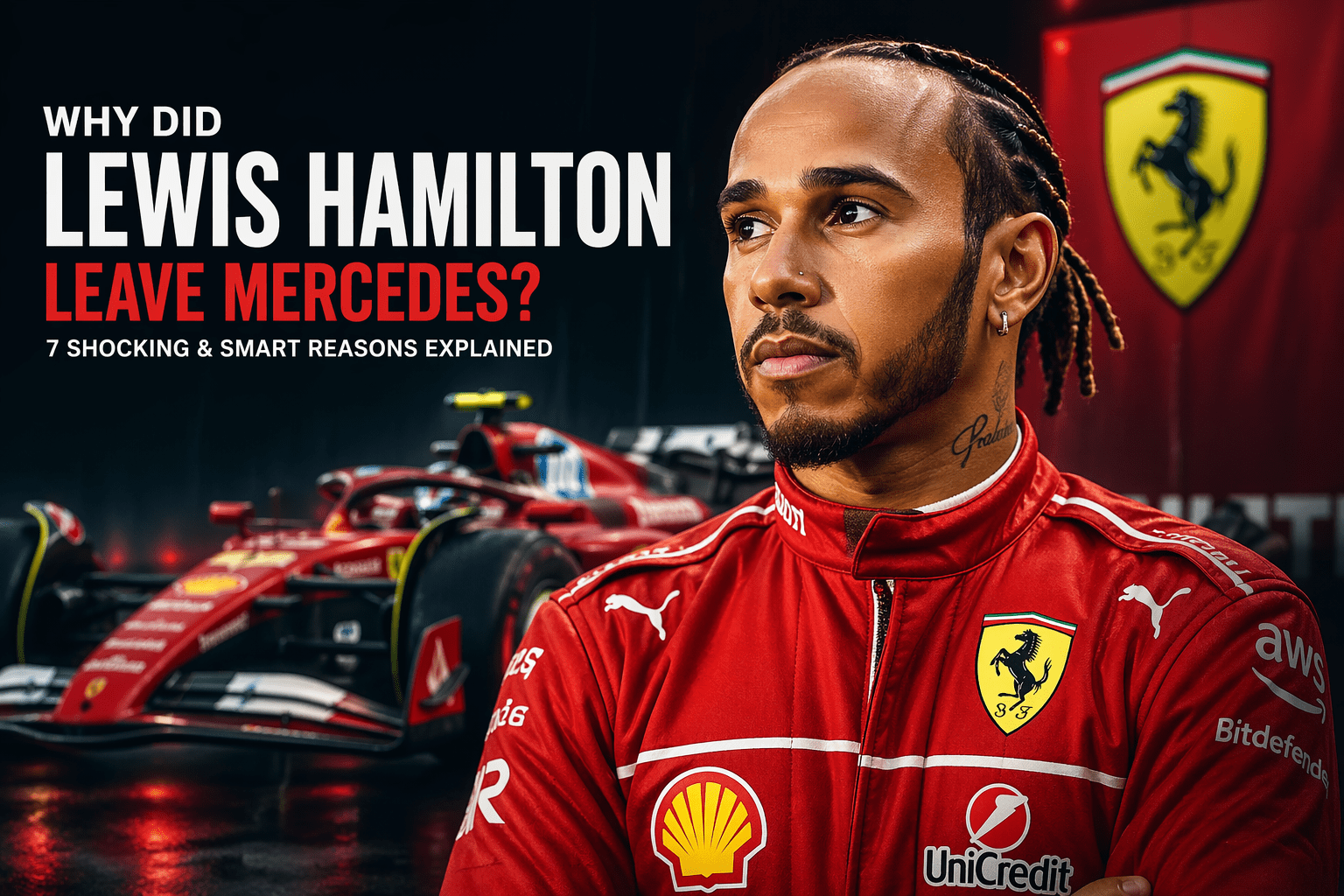
Why did Lewis Hamilton leave Mercedes—a question that still echoes through the paddock like a late-braking overtake.
When Lewis Hamilton announced his move from Mercedes-AMG Petronas Formula One Team to Scuderia Ferrari for the 2025 season, it wasn’t just a transfer—it was a seismic shift in modern Formula 1.
At face value, it looked emotional. Underneath, it was deeply strategic.
Let’s unpack the real reasons.
1. Legacy Complete at Mercedes
Hamilton’s chapter with Mercedes wasn’t unfinished—it was legendary.
- 7 World Championships (tying Michael Schumacher)
- 100+ race wins
- Dominance across an entire F1 era
From a career optimization standpoint, staying longer had diminishing returns. The marginal value of another Mercedes season simply couldn’t match the upside of a bold move.
2. Ferrari: The Final Dream
Every elite F1 driver has a checklist. Ferrari is usually the last—and most romantic—box to tick.
Driving for Ferrari isn’t just employment; it’s legacy theatre. Even Fernando Alonso and Schumacher were drawn to it.
For Hamilton, this wasn’t a mid-career gamble—it was a career-defining epilogue.
3. Mercedes’ Performance Dip (2022–2023)
Here’s where your clarification sharpens the narrative.
Following the 2022 regulation overhaul:
- Mercedes struggled with car concept issues (notably porpoising early on)
- They failed to consistently challenge Red Bull Racing
- Hamilton endured two winless seasons (2022 & 2023)
For a driver calibrated to win, that’s not just frustrating—it’s decisive.
This wasn’t panic. It was pattern recognition.
4. The Desire for a Fresh Challenge
Elite athletes don’t just compete—they evolve.
At this stage, Hamilton wasn’t chasing statistics. He was chasing:
- New engineering philosophies
- Different team dynamics
- A unique competitive environment
Winning with Ferrari would mean something fundamentally different than winning with Mercedes.
It’s the difference between repeating success and redefining it.
5. Contract Clause & Non-Poaching Reality
This is the most overlooked—but critical—layer.
Hamilton activated an exit clause in his 2023 Mercedes contract extension. However, that agreement included a non-poaching clause, which prevented him from bringing key Mercedes personnel (like long-time race engineer Peter Bonnington) to Ferrari immediately.
Implications:
- He had to integrate into an entirely new technical ecosystem
- No immediate continuity advantage
- Greater adaptation risk
In other words, this wasn’t a “plug-and-play” move—it was a full reset.
6. Strategic Timing for 2026 Regulations
Formula 1 isn’t just about the next race—it’s about the next rule cycle.
With major regulation changes coming in 2026:
- Hamilton joins Ferrari early (2025)
- Builds internal alignment
- Influences development direction
This is long-horizon thinking—something championship-winning drivers consistently excel at.
7. Long-Term Vision Beyond Racing
Ferrari’s appeal extended beyond the cockpit.
The deal reportedly included:
- Brand ambassadorial roles
- Long-term collaboration opportunities
- A platform aligned with Hamilton’s global influence
This wasn’t just a contract—it was a post-career architecture.
More Articles You Shouldn’t Miss
Renault Duster 2026 – The Comeback of the SUV That Refuses to Quit
TVS Orbiter v1: A New Electric Scooter That Could Redefine City Riding
Skoda Kushaq Facelift 2026: Bold Upgrade or Overhyped Refresh? (Full Review)
Final Verdict
So, why did Lewis Hamilton leave Mercedes?
Because the equation changed.
- Performance trajectory declined
- Personal legacy plateaued
- A rare opportunity emerged
And most importantly:
Great drivers don’t just follow winning cars—they chase defining moments.
Hamilton didn’t leave because Mercedes failed him.
He left because Ferrari offered something Mercedes no longer could: a new story worth telling.